Low cost of production, durability and flexibility is why plastics are chosen for use in many industries. Plastics are polymers meaning they are a long chain of monomers (basically molecules). I just went down this drain trying to understand more about polymers but listing them all down here will turn this to a chemistry class (that is done in the "Could This Work?" category of Mu2Verse though). But the thing to understand here which will help us solve our question is that the durability property is coming from the strong covalent C-C bond.

(source: google images: https://sciencenotes.org/covalent-bond-definition-and-examples/)
C-C bond here will have 4 stable bonds creating a tightly bound structure that can resist water and simple type of chemical reactions. Longer the molecular chain, higher the force of resistance and higher the durability. If you have read about the bleach washing of paper and how bad idea that is in the page under "Could This Work?" section, you would know how the length of the fiber determines the strength of the paper to resist tear.
If the bonding is strong then how are sheets bendable. That is because of plasticiser, an additive added to increase the fluidity of the material. Essentially, they make embed themselves in the polymer making the intermolecular forces weak between the C-C bonds.

(source: Google Images: https://www.youtube.com/watch?v=ttmt906Bsys)
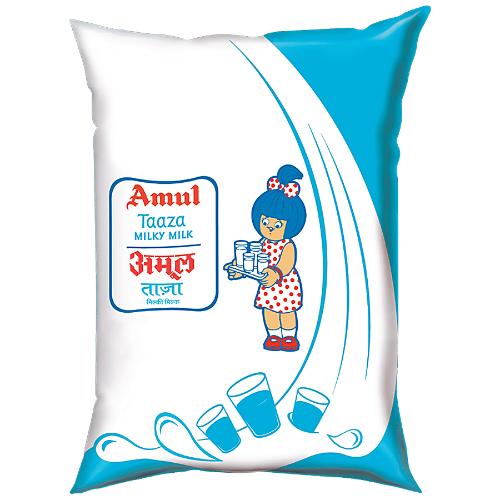
Now we need to also know how plastic is a "low cost of production" material? but I think going through the process will be super irrelevant here, but we need to note a few numbers in the back of our head for better understanding. On average it takes 100Rs to produce a kg of plastic sheet and putting that into perspective comparing the cost of production for the plastic used to make a plastic bottle (again even that has the plasticisers added to them as well) is on average 125 Rs per kg. So, I think the cost factor is one of the reason here. Let's compute the storage volume in a room of 10m-by-10m-by-10m dimension. The volume of the room is 1000m^3 and let's assume the bottle that will be required for 600ml of milk +gas has volume of 0.0006m^3 and then the cap volume added is around 0.00065 m^3. So, the total number of bottles that assuming have the same shape as the amount of milk in them without any extra space for air or cap, is 15.38 Lakh bottles. Now let's come for the milk packet for the same 600ml but now without the cap, it comes to 16.66 Lakh packets. Crazy benefit by using the packet instead of bottle.
Cost of production and storage upper-hand computed, it's pretty clear why this packet material is used. But that again gives rise another question that is why square and not circle?

(source: Google Images: https://www.geeksforgeeks.org/dsa/program-to-calculate-area-of-an-circle-inscribed-in-a-square/)
Simple... compute the volume of a sphere taking assuming the r is roughly 7.5 cm, comes to 0.00176m^3. That gives us 5.68 Lakh milk packets that can be stored that are spherical in shape which is nothing compared to the 16.66 lakh advantage i am getting as a business owner.